
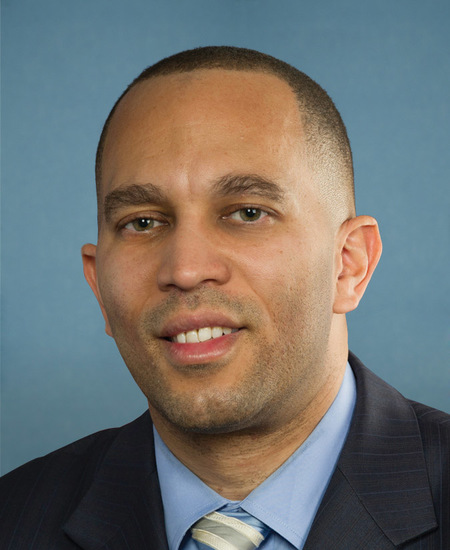
House Minority Leader Hakeem Jeffries has voiced strong opposition to recent Republican legislative proposals aimed at implementing more stringent voter identification and proof of citizenship requirements for participation in federal elections. Jeffries asserts that these measures constitute an attempt at voter suppression.
The proposed legislation seeks to mandate government-issued photo identification and documented proof of U.S. citizenship, arguing that such requirements are necessary to safeguard election integrity against potential fraud. This debate reflects a longstanding partisan divide over election laws.
What the Left Is Saying
Democrats, led by Jeffries, argue that stricter voter ID and citizenship laws disproportionately impact minority groups, low-income individuals, students, and the elderly, who may face greater hurdles in obtaining the required documentation. They contend that these laws are designed to disenfranchise legitimate voters.
Advocacy groups aligned with the left emphasize that instances of in-person voter fraud are exceedingly rare and that such legislative efforts are a solution in search of a problem, serving primarily to suppress turnout among historical Democratic constituencies. They champion policies that expand voter access, such as automatic voter registration and same-day registration.
What the Right Is Saying
Republicans counter that these measures are essential to ensure the security and legitimacy of the electoral process. They argue that requiring photo identification and proof of citizenship is a common-sense safeguard that most Americans support and that it prevents illegal voting.
Proponents on the right maintain that the integrity of 'one person, one vote' is paramount and that critics exaggerate the difficulty of acquiring necessary documents. They highlight polls suggesting public support for voter ID laws as evidence that the measures are not inherently discriminatory but rather broadly desired by the electorate.
What the Numbers Show
Studies on the impact of voter ID laws have yielded mixed results, with some suggesting minor decreases in turnout among certain demographics, while others find no statistically significant impact. Data on voter fraud, particularly in-person fraud, consistently show it to be a negligible factor in U.S. elections.
For example, a 2012 study by the Brennan Center for Justice found that voter impersonation is rarer than being struck by lightning. However, public perception surveys often indicate significant concern among voters regarding potential fraud, contributing to the political impetus for such legislation.
The Bottom Line
The renewed push for stringent voter ID and citizenship requirements by Republicans, and the robust opposition from Democrats, signals a continuing front in the battle over voting rights and election administration. This legislative clash underscores fundamental differences in how each party views access versus security in democratic participation.
The debate is likely to intensify as the next election cycle approaches, with both sides mobilizing their bases around arguments of safeguarding democracy and protecting civil rights.