
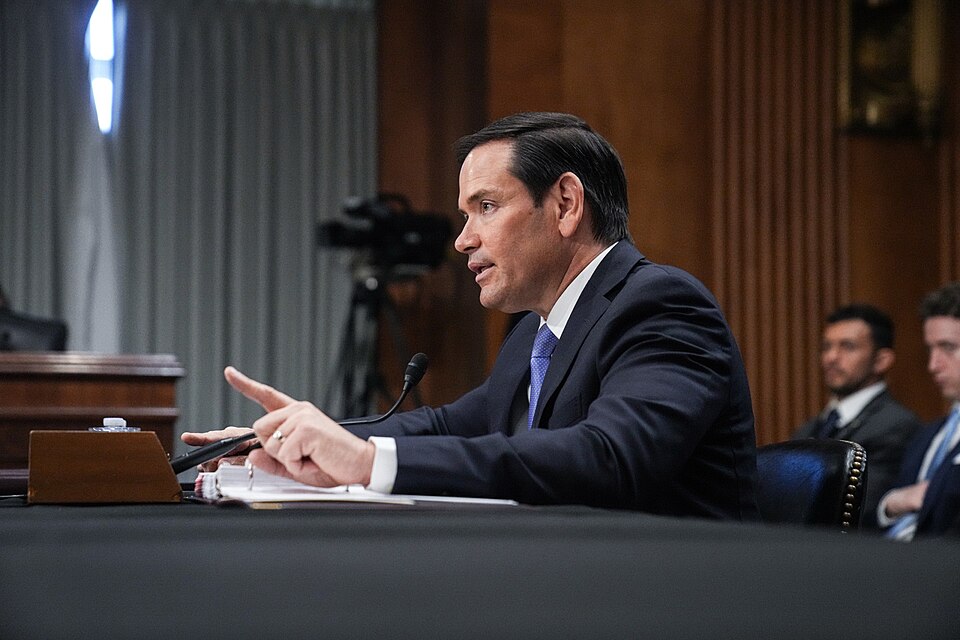
Secretary of State Marco Rubio testified Tuesday in the federal trial of former Miami congressman David Rivera, who is accused of secretly lobbying members of Congress and the White House on behalf of former Venezuelan President Nicolás Maduro's government without registering as a foreign agent.
Rivera, 60, a Republican who served in the U.S. House from 2013 to 2017, was arrested in December 2022 on charges of money laundering and representing a foreign government without registering. He has pleaded not guilty.
In his testimony, Rubio described his personal relationship with Rivera, saying they became "very close" while overlapping for six years in the Florida Legislature in the early 2000s. The two also later served together in Congress.
According to Rubio's testimony, in July 2017 he received a call from Rivera saying he needed to discuss Venezuela urgently. The next morning, Rivera traveled to Washington and met with Rubio at his home, explaining he was working with Raul Gorrin, a Venezuelan media magnate who served as Rivera's main conduit to the Maduro government, on a plan to persuade Maduro to step aside.
"I was skeptical," Rubio testified. "The Maduro government was full of 'double dealers' who were constantly pitching plans to betray Maduro." He added that if there was even a 1% chance the proposal was real and he had a role to play alerting the White House, he was open to doing that.
Within days, Rubio used talking points provided by Rivera to deliver a speech on the Senate floor signaling the U.S. would not retaliate against Venezuelan government insiders who worked to push Maduro from power. "He provided me with insight into some of the key phrases that regime insiders would've wanted to hear to know this was serious," Rubio testified. "No vengeance, no retribution."
The indictment against Rivera contains no indication that Rubio acted improperly as a senator at the time.
What the Left Is Saying
Progressive critics have raised concerns about the broader implications of the case, questioning how close foreign lobbying efforts came to influencing U.S. policy at the highest levels. While Rubio was not charged, some Democrats have noted that the episode illustrates the risks of close political relationships being exploited by foreign governments seeking to influence American democracy.
The prosecution argued in opening statements that the case demonstrates how foreign autocrats can exploit political connections. "This case is about two things: greed and betrayal," prosecutor Roger Cruz said Monday. "For $50 million, these two defendants made a pact to secretly lobby for Nicolás Maduro."
What the Right Is Saying
Conservative defenders of Rivera have emphasized that his legal work was focused on commercial issues, specifically luring Exxon Mobil back to Venezuela, which would be exempt from Foreign Agents Registration Act requirements. Rivera's attorney argues his client's one-man firm, Interamerican Consulting, was hired by an American subsidiary of Venezuela's state-owned oil company — not the Venezuelan government itself.
The defense has further distinguished Rivera's commercial consulting work from his separate efforts with the Venezuelan opposition to pave the way for Maduro's exit, arguing these were wholly distinct activities. Republicans have also pointed out that Rubio's testimony explicitly stated he was skeptical of the plan and that there is no allegation in the indictment that Rubio acted improperly.
What the Numbers Show
The case centers on a $50 million consulting contract that Rivera signed with Venezuela's socialist government. The indictment alleges that at the start of the Trump administration, Rivera was part of a conspiracy to lobby on behalf of Venezuela to lower tensions with the U.S., resolve a legal dispute with a U.S. oil company and end U.S. sanctions against the South American nation.
Prosecutors say Rivera and his co-defendant attempted to arrange meetings for then-Foreign Minister Delcy Rodríguez — now Venezuela's acting president — in Dallas, New York, Washington and Caracas with White House officials, members of Congress and the CEO of Exxon Mobil. To conceal their activities, prosecutors said they used a chat group called MIA — for Miami — with Spanish code words including "Little Cuban" for Rubio, "The Lady in Red" for Rodríguez and "melons" for millions of dollars.
The Bottom Line
The trial puts a spotlight on foreign influence attempts targeting U.S. officials through personal relationships. While Rubio's testimony depicted him as cautious and skeptical of Rivera's proposals, the case raises questions about how foreign governments might use political connections to access American policymakers. The prosecution must prove that Rivera's work constituted political lobbying rather than commercial consulting — a distinction that will determine whether he violated FARA. The case is expected to continue for several weeks.