
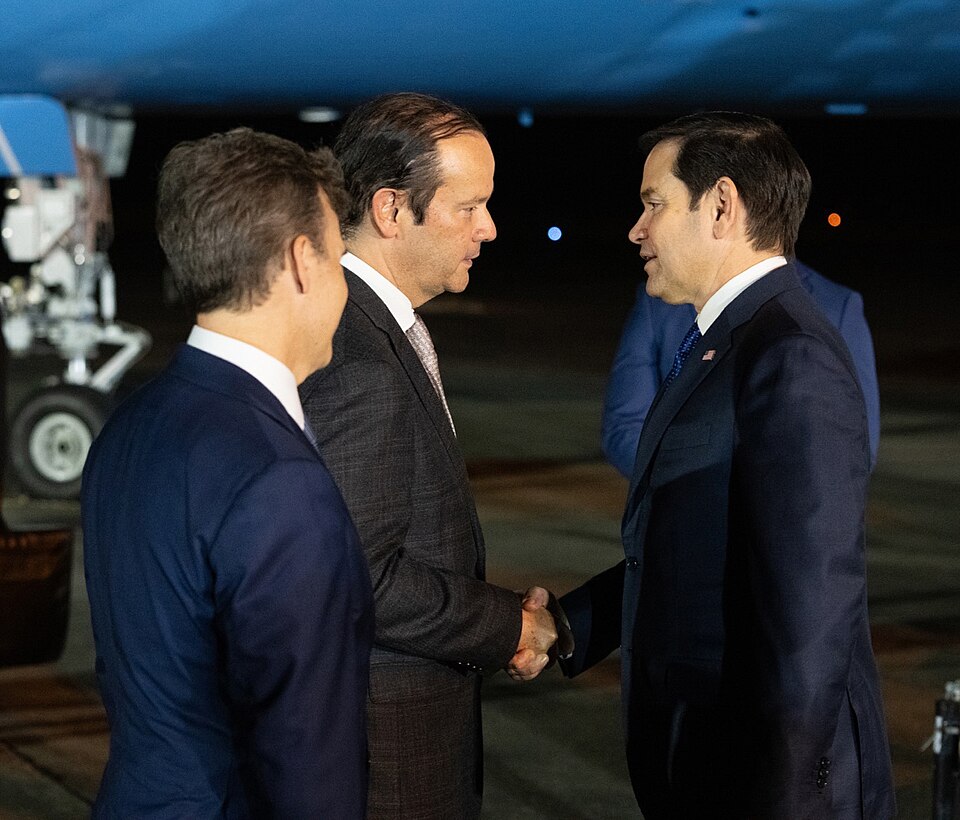
Secretary of State Marco Rubio arrived in Europe on Friday for talks with foreign ministers of the Group of 7 nations, meeting with allies who are seething over the U.S. and Israel war against Iran but face pressure to cooperate and limit the fallout.
The G7 foreign ministers ministerial is taking place in Cernay-la-Ville, France. The meeting comes at a critical moment in the four-week conflict. President Trump has touted progress in negotiations with Iran to find an off-ramp, but is sending thousands of troops to the region, signaling a possible ground invasion.
What the Right Is Saying
The Trump administration insists European allies must share the burden of securing global shipping, particularly through the Strait of Hormuz, which Iran has effectively shut down since the war began at the end of February.
"I think they should be happy that I'm going," Rubio said ahead of his departure Thursday. "Well, again, I'm not there to make them happy."
Rubio added that other countries should "step up" to help secure the Strait of Hormuz, arguing it's their responsibility because they are more dependent on fuel that moves through the shipping route. "It can be open tomorrow if Iran stops threatening global shipping, which is an outrage, and a violation of international law," he said.
Trump has lashed out at European countries for holding back support. He called Germany's statement that the war is "not our war" an inappropriate comment, comparing it to Ukraine: "Well, Ukraine's not our war, but we help."
Trump's special envoy for peace missions, Steve Witkoff, said Thursday that he has delivered through Pakistani intermediaries a 15-point "action list" to Iran meant to form the framework of a peace deal. "If we can convince Iran that this is the inflection point with no good alternatives for them other than more death and destruction — we have strong signs that this is a possibility," Witkoff said.
What the Left Is Saying
Progressive critics and some European allies express deep concern about being drawn into a conflict they were not consulted on. German Defense Minister Boris Pistorius has said 'it's not our war,' a position Trump called 'inappropriate.'
European populations are wary of getting brought into a conflict they were not involved in, according to Sudha David-Wilp, vice president of external reactions for the German Marshall Fund. She noted that European countries also worry about maintaining U.S. support for Ukraine while navigating this new crisis.
"They need the United States to continue cooperating on Ukraine, and so there is this sense that they don't want to outright reject what the administration is asking because it is in Europe's interest and necessary to have a constructive relationship with the White House," David-Wilp said. "But they don't see the strategic objective nor the strategy to say we're all in."
European allies see the fighting as incredibly destabilizing and dangerous, though they have no love lost for an Iranian regime that has oppressed its own people, funded terrorist attacks and stonewalled nuclear inspections.
What the Numbers Show
The war has been underway for four weeks. Southern Europe is in range of Iranian ballistic missiles, with military bases under attack and citizens stranded in the region.
Trade through the Strait of Hormuz has halted, sending economies into chaos with spiking energy prices and lack of access to needed fertilizer. The G7's joint statement last week said member countries "stand ready to take necessary measures to support global supply of energy."
Trump praised Iran for allowing 10 Pakistani-flagged oil tankers to transit the Strait of Hormuz in recent days as a sign of goodwill. The G7 ministerial will include representatives from Canada, France, Germany, Italy, Japan, the United Kingdom, the European Union, Saudi Arabia, India, Brazil, South Korea and Ukraine.
The Bottom Line
The G7 meeting will focus on potential avenues for negotiation leading to de-escalation, reopening the Strait of Hormuz and "the cessation of the Iranian regime's nuclear and ballistic missile programs," according to a French Foreign Ministry briefing.
European allies have a strong preference for resolving the conflict through diplomacy, but there is little clarity about what terms are being negotiated. Ian Lesser of the German Marshall Fund said European countries are comfortable discussing coordinated responses on energy security and maritime security, but "American demands for European participation in near term military dimensions of the war would be met with a lot of skepticism."
The summit will also address Ukraine, the Indo-Pacific, Sudan, Haiti, Gaza and Venezuela. What happens next depends on whether Iran accepts the 15-point peace framework and whether European allies can be persuaded to take a more active role in supporting the U.S. position.