
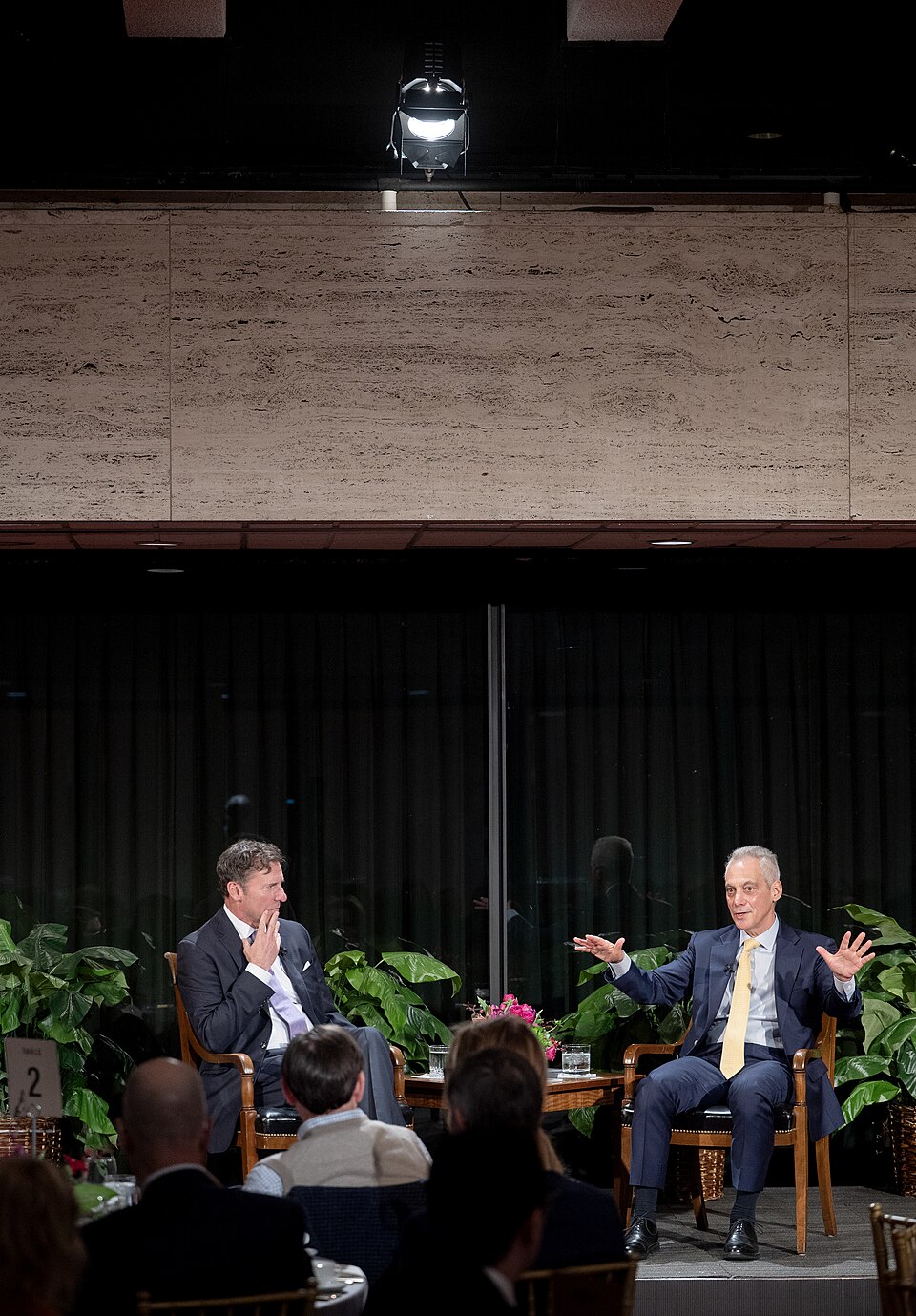
Rahm Emanuel, the former White House chief of staff under President Barack Obama and mayor of Chicago, has delivered a blunt assessment of his own party: Democrats, he argues, have "lost the plot." In a recent appearance on the Reason podcast "The Fifth Column," Emanuel offered a sweeping critique of how the party has shifted away from economic populism toward cultural advocacy, a transformation he says has cost Democrats their connection to working-class voters.
The diagnosis, whatever its source, is correct, Emanuel said. He traced the party's struggles to what he called four defining moments of the first quarter of the 21st century: the Iraq War, the financial meltdown, China's unchecked rise, and COVID-19. In each case, he argued, the well-connected were not held to account while everyone else paid the price. Trump, contrary to what people say, did not create the anger that followed. He capitalized on it.
Emanuel acknowledged that he may not be the one to carry the party's revival, noting his status as a polarizing figure with real baggage. But he argued that whether he can win is separate from whether his analysis is right. "We have to prove we can fight for America," Emanuel said, "not just fight Trump."
What the Left Is Saying
Progressive Democrats and progressive activists have largely rejected Emanuel's framing. Many argue that the party lost in 2024 not because it moved too far left on culture, but because it failed to deliver on kitchen-table issues like housing costs and healthcare affordability. Some progressive analysts contend that Democratic losses stem from voter perceptions of the party's economic handling, not cultural positions.
Progressive critics also note that Emanuel's own record as Chicago mayor — marked by tensions over police practices and school closures in Black communities — makes him an unlikely messenger for a party trying to reconnect with working-class voters. The Congressional Black Caucus and other key progressive constituencies have been skeptical of Emanuel's political rehabilitation.
Additionally, some Democrats argue that Trump's victory was not a mandate for his policy agenda but rather a rejection of incumbent party fatigue, and that the party's focus on democracy and institutional preservation remains the correct approach. They contend that Democratic policies, when properly communicated, remain popular with voters across income brackets.
What the Right Is Saying
Conservatives have largely embraced Emanuel's critique, though many note it comes from a figure who was part of the Democratic establishment they blame for the party's current position. Republican strategists argue that Emanuel's diagnosis confirms what they have long argued: that the Democratic Party abandoned its New Deal coalition in favor of progressive cultural priorities.
Many conservative commentators have pointed to the 2024 results as validation of Emanuel's thesis. Exit polls showed Trump making inroads with working-class voters across racial groups, and Republicans argue this reflects a fundamental realignment. Conservative analysts note that Obama's deportation record — more than 3 million people over two terms — demonstrates what a moderate Democratic approach to immigration enforcement looks like, and they argue such an approach could help the party recover swing voters.
Some on the right have also noted that Emanuel himself represents the "establishment" wing of the Democratic Party that progressive voters rejected, making his 2028 ambitions uncertain at best. Republican critics argue that any Democratic candidate who echoes Emanuel's message will face the same voter backlash from progressive activists who dominate primary electorals.
What the Numbers Show
The 2024 election results showed Trump winning battleground states with significant gains among working-class voters. The Democratic Party's coalition shrank compared to 2020, with losses particularly pronounced among voters without college degrees across racial groups. Exit polling indicated that economy and inflation were the top concerns for a majority of voters.
Historical patterns offer some context. Democrats have broken extended losing streaks before by nominating candidates who could speak to voters outside the coastal donor class. Jimmy Carter won in 1976 after George McGovern's loss in 1972. Bill Clinton won in 1992 after three consecutive Republican presidential victories. Both candidates ran as pragmatic moderates with strong ties to their regions.
Obama's deportation record stands at more than 3 million removals over his two terms, a figure that immigration advocates used to criticize his administration. This enforcement-heavy approach is notable given the progressive direction the party has taken since 2016.
Recent polling shows voters split on whether Democrats have moved too far left or are still fighting for working-class interests. Economic trust remains a weakness for the party, while voters increasingly see Republicans as better positioned to handle inflation and jobs.
The Bottom Line
Emanuel's critique represents one of the most prominent establishment voices questioning the party's direction since the 2024 election. His argument — that Democrats must reconnect with working-class voters on economic populism rather than relying solely on anti-Trump messaging — has found resonance among some party strategists. Whether Emanuel himself can deliver that message as a 2028 candidate remains uncertain, given his polarizing history. What is clearer is that the Democratic primary field will likely feature a debate over the party's ideological direction, with Emanuel's analysis serving as one touchstone for those arguing the party must recalibrate toward the center-left rather than the progressive wing. The National Action Network convention in New York showcased a crowded field of potential 2028 candidates, with varying degrees of embrace for Emanuel's framing. The coming months will test whether any candidate can articulate the economic populist message Emanuel advocates while maintaining unity within a party still processing its 2024 loss.